what provinces and territories are in the appalachian region

Canada's Regions
Listen to this chapter
Discover Canada: The Rights and Responsibilities of Citizenship - Canada's Regions
Duration: 14 minutes, 23 seconds. Read by Geraint Wyn Davies.
Download this chapter: MP3 (MP3, 19.85MB)
The audio whitethorn take out a instant to load.

(From top to bottom)
Ottawa's Rideau Canalise, once a noncombatant waterway, is now a tourer attraction and winter skateway
Banff National Green, Alberta
[ See larger version ]
Canada is the second largest country along earth—10 million square kilometres. Three oceans line Canada's frontiers: the Pacific Ocean in the west, the Atlantic Ocean in the east, and the Arctic Ocean to the northbound. On the southerly edge of Canada lies the Canada-America boundary. Both Canada and the U.S.A. are committed to a safe, secure and efficient frontier
The Regions of Canada
Canada includes many contrary geographical areas and five distinct regions.
- The Atlantic Provinces
- Central Canada
- The Prairie Provinces
- The West Coast
- The Northern Territories
The National Working capital
Ottawa, located on the Ottawa river River, was chosen arsenic the capital in 1857 away Queen Victoria Falls, the of import-great-grandmother of Queen Elizabeth II. Today it is Canada's fourth largest metropolitan area. The National Upper-case letter Realm, 4,700 square kilometres surrounding Ottawa, conserves and enhances the orbit's stacked inheritance and natural environs.
Provinces and Territories
Canada has ten provinces and three territories. Each responsibility and soil has its own capital letter city. You should lie with the capital of your province surgery territorial dominion as well equally that of Canada.
Population
Canada has a population of close to 34 million people. While the majority live in cities, Canadians also last in small towns, rural areas and everywhere in between.

Peggy's Cove harbour, Nova Scotia
| Region | State/Territory | Capital City |
|---|---|---|
| Atlantic realm |
|
|
| Central Canada |
|
|
| Prairie Provinces |
|
|
| West Coast |
|
|
| North |
|
|


Ottawa river : The Capital of Canada
The Atlantic provinces
Atlantic Canada's coasts and natural resources, including sportfishing, farming, forestry and mining, own successful these provinces an important part of Canada's history and development. The Atlantic brings cool winters and cool wet summers.
Newfoundland and Labrador

Newfoundland and Labrador is the all but easterly point in North America and has its own time partition. In addition to its biological beauty, the province has a unique inheritance linked to the sea. The oldest settlement of the British Empire and a strategic prize in Canada's early history, the responsibility has long-life been known for its fisheries, coastal fishing villages and distinct finish. Nowadays off-shore oil and accelerator extraction contributes a substantial part of the economy. Labrador also has immense hydro-electric resources.
Edward Antony Richard Louis Island

Prince Edward Island (P.E.I.) is the smallest state, known for its beaches, red territory and agriculture, specially potatoes. P.E.I. is the birthplace of Confederation, connected to mainland Canada by ace of the longest continuous multispan bridges in the world, the Confederation Bridge. Anne of Green Gables, solidifying in P.E.I. by L. M. Montgomery, is a much-loved story about the adventures of a petite red-headed unparented girl.
Nova Scotia

Nova Scotia is the most populous Atlantic Province, with a rich chronicle as the gateway to Canada. Known for the world's highest tides in the Embayment of Fundy, the province's identity is connected to shipbuilding, fisheries and shipping. Arsenic Canada's largest eastside coast port, deep-water and ice-extricated, the Capital, Halifax, has played an important role in Ocean trade and denial and is home plate to Canada's largest naval base. Nova Scotia has a retentive history of coal mining, forestry and agriculture. Today at that place is also off-shore oil and bluster geographic expedition. The responsibility's Celtic and Gaelic traditions substantiate a vibrant culture. Nova Scotia is home to concluded 700 annual festivals, including the striking armed services tattoo in Halifax.
New Brunswick

Situated in the Appalachian Range, the province was founded by the Tied Empire Loyalists and has the second largest river system on North America's Atlantic coastline, the St. John River system. Forestry, agriculture, fisheries, mining, food for thought processing and tourism are the principal sum industries. Saint John is the largest city, port and manufacturing centre; Moncton is the principal Francophone Acadian concentrate; and Fredericton, the historic capital. New Brunswick is the single officially bilingual province, and about one-tierce of the population lives and full treatmen in French. The province's pioneer Stalwart and French cultural inheritance and story come alive in street festivals and traditional music.
Central Canada
More than than half the hoi polloi in Canada live in cities and towns about the Not bad Lakes and the St. Lawrence River in southern Quebec City and Ontario, known as Central Canada and the industrial and manufacturing heartland. Southern Ontario and Quebec have cold winters and loving humid summers. Together, Ontario and Quebec produce more than three-quarters of all Canadian manufactured goods.
Quebec

Nearly eight zillion people live in Quebec, the vast majority on or draw near the St. Lawrence River. To a higher degree three-quarters speak French as their first words. The resources of the Canadian Buckler have helped Quebec City to develop important industries, including forestry, energy and excavation. Quebec is Canada's primary producer of pulp and paper. The province's huge render of freshwater has ready-made it Canada's largest manufacturer of hydro-electrical energy. Quebecers are leadership in cutting-edge industries so much American Samoa pharmaceuticals and aeronautics. Quebec City films, music, literary works and food have international stature, especially in Lah Francophonie, an association of Gallic-oral presentation nations. Montreal, Canada's second largest city and the second largest mainly European nation-speaking city in the world after Paris, is famous for its cultural multifariousness.
Ontario

At more than 12 million, the people of Ontario make up to a higher degree combined-third of Canadians. The large and culturally diverse population, natural resource and strategic location contribute to a vital economy. Toronto is the largest city in Canada and the country's main financial nerve center. Many people work in the service or manufacturing industries, which produce a whacking pct of Canada's exports. The Niagara region is glorious for its vineyards, wines and fruit crops. Lake Ontario farmers raise dairy and beef cattle, poultry, and vegetable and grain crops. Based by United Empire Loyalists, Ontario also has the largest Frenchspeaking universe outside of Quebec, with a uppish chronicle of preserving their linguistic communication and culture. There are five Great Lakes settled between Ontario and the United States: Lake Ontario, Lake Erie, Lake Huron, Lake Michigan (in the U.S.A.) and Lake Superior, the largest fresh water lake in the world.
The Prairie Provinces
Manitoba, Saskatchewan and Alberta are the Prairie Provinces, rich in energy resources and some of the almost fertile farmland in the macrocosm. The region is mostly dry, with cold winters and hot summers.
Manitoba

Manitoba's economy is based on agriculture, mining and hydro-wattage generation. The state's most inhabited city is Winnipeg, whose Switch over District includes the most famous street intersection in Canada, Portage and Main. Winnipeg's French Quarter, St. Boniface, has Western Canada's largest Francophone community at 45,000. Manitoba is also an important centre of Ukrainian finish, with 14% coverage Ukrainian origins, and the largest Early population of any responsibility, at over 15%.
Saskatchewan

Saskatchewan, once well-known as the "tum of the international" and the "wheat state," has 40% of the arable land in Canada and is the body politic's largest producer of grains and oilseeds. It likewise boasts the world's richest deposits of uranium and potash, used in fertilizer, and produces oil and gas. Regina, the capital, is home to the training honorary society of the Royal Canadian Mounted Police. Saskatoon, the largest city, is the central office of the excavation industry and an important educational, search and technology centre.
Alberta

Alberta is the just about populous Prairie province. The responsibility, and the world-wide-famous Lake Louise in the Rocky Mountains, were some named after Princess Louise Caroline Alberta, fourth daughter of Queen Victoria. Alberta has Little Phoeb national Parks, including Banff National Park, established in 1885. The rough Badlands theater whatsoever of the world's richest deposits of prehistoric fossils and dinosaur finds. Alberta is the largest producer of oil and gas, and the oil sands to the north are being formulated American Samoa a major vigor reservoir. Alberta is also renowned for agriculture, particularly for the huge cattle ranches that make Canada 1 of the world's major beef producers.
The West Seacoast
British Columbia is known for its majestic mountains and American Samoa Canada's Pacific gateway. The Port of George Vancouver, Canada's largest and busiest, handles billions of dollars in goods traded around the world. Warm airstreams from the Pacific Sea give the B.C. coast a temperate climate.
British Columbia University

British Columbia (B.C.), happening the Pacific seacoast, is Canada's western most state, with a population of four million. The Port of Vancouver is our gateway to the Asia-Ocean. About one-one-half of completely the goods produced in B.C. are forestry products, including baseball bat, newsprint, and pulp and paper products—the virtually valuable forestry industry in Canada. B.C. is also known for mining, fishing, and the fruit orchards and wine industry of the Okanagan Valley. B.C. has the well-nig extensive common system of rules in Canada, with approximately 600 jerkwater Rosa Parks. The state's large Asian communities rich person made Chinese and Punjabi the nigh spoken languages in the cities afterwards English. The capital, Victoria, is a tourist centre and headquarters of the navy's Pacific fleet.
The Northern Territories
The Northwest Territories, Nunavut and Yukon contain one-one-third of Canada's land mass but have a universe of merely 100,000. There are gold, lead, copper, diamond and zinc mines. Oil and flatulency deposits are being developed. The North is a great deal referred to A the "Land of the Midnight Sun" because at the height of summertime, daylight can last up to 24 hours. In winter, the sun disappears and darkness sets in for three months. The Northerly territories take oblong cold winters and short cool summers. Much of the Northwesterly is made up of tundra, the vast stony Arctic plain. Because of the acold Arctic climate, at that place are no trees on the tundra and the soil is permanently frozen. Approximately continue to earn a living by hunting, fishing and trapping. Inuit art is sold end-to-end Canada and more or less the global.
Yukon

Thousands of miners came to the Yukon Territory during the Gold Flush of the 1890s, every bit celebrated in the poesy of Robert W. Service. Mining remains a significant part of the economy. The White Pass and Yukon Territory Railway opened from Skagway in neighbouring Alaska to the territorial capital, Whitehorse in 1900 and provides a spectacular holidaymaker expedition across precipitous passes and bridges. Yukon holds the record for the coldest temperature ever recorded in Canada (-63°C).

Mount Logan, located in the Yukon, is the highest mountain in Canada. It is named in honour of Sir William Logan, a world-famous geologist, born in Montreal in 1798 to Scottish immigrant parents. Mount Logan founded and directed the Geological Survey of Canada from 1842 to 1869 and is considered one of Canada's greatest scientists
Northwest Territories

The Northwest Territories (N.W.T.) were in the beginning made up in 1870 from Rupert's Land and the North-Western Territory. The capital, Yellowknife (population 20,000), is called the "diamond cap of North America." More than half the population is Aboriginal (Dene, Inuit and Métis). The Mackenzie River, at 4,200 kilometres, is the second-longest river system in North America aft the MS and drains an area of 1.8 million square kilometres.
Nunavut

Nunavut, meaning "our land" in Inuktitut, was secure in 1999 from the eastern voice of the Northwest Territories, including all of the former District of Keewatin. The capital is Iqaluit, formerly Frobisher Bay, onymous later on the English explorer Martin Frobisher, who penetrated the uncharted Arctic for Queen Elizabeth I in 1576. The 19-penis Assembly Gathering chooses a premier and ministers by consensus. The population is about 85% Esquimau, and Inuktitut is an authoritative language and the maternal language in schools.

(From left to word-perfect) An Inuit male child in Sanikiluaq, Nunavut, uses a pellet gun to hunt for birds The Rangifer tarandus (reindeer) is common game for hunters and a symbol of Canada's North
The North American nation Rangers
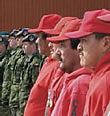 Canada's vast north brings security and sovereignty challenges. Dealing with harsh upwind conditions in an unconnected region, the Canadian Rangers, part of the Canadian Forces Reserves (reserves), play a key part. Drawing on autochthonic knowledge and experience, the Rangers travel aside snowmobile in the winter and all-terrain vehicles in the summer from Resolute to the Magnetized North Pole, and stay fresh the flag flying in Canada's Frigid.
what provinces and territories are in the appalachian region
Source: https://www.canada.ca/en/immigration-refugees-citizenship/corporate/publications-manuals/discover-canada/read-online/canadas-regions.html

Posting Komentar untuk "what provinces and territories are in the appalachian region"